
Ballot Shortages and Shaken Official Discipline: The Challenges Left b…
페이지 정보

본문
The Ballot Shortage Crisis and Shaking Public Discipline: Challenges Left by the Jamsil Counting Center Protests
Date: June 09, 2026 | IT/Media Current Affairs Columnist
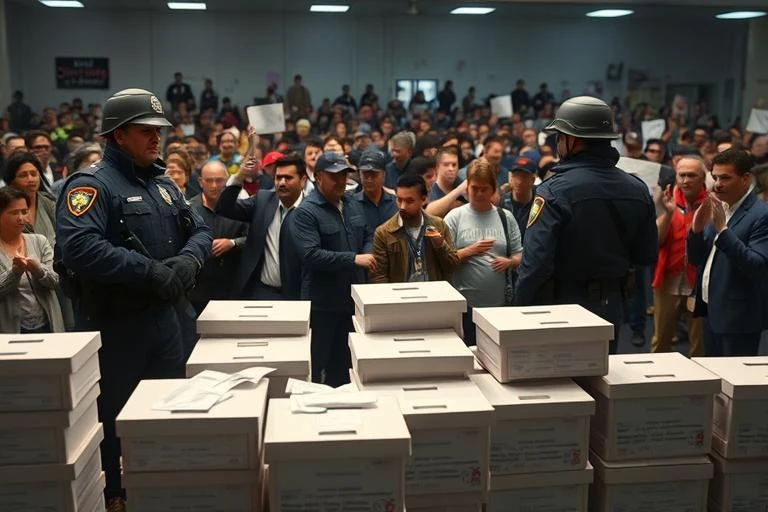
The aftershocks of the June 3rd local elections are rocking South Korea. What was initially dismissed as a simple administrative error—the ballot shortage crisis—has spiraled into unprecedented chaos, marked by tens of thousands of protesters filling the Olympic Park Handball Gymnasium and a vacuum in police leadership. With the counting center, which should be a symbol of transparent democracy, now blockaded by public distrust and protest, it is time to examine the reality of this conflict and the heavy shadow cast over the public service sector.
At the heart of this crisis lies the fierce backlash from citizens surrounding the Jamsil counting center. The protests demanding a re-election, which began on the 4th, have not subsided after five days; instead, they have gained momentum, with the crowd surging to 18,000 people after working hours. Citizens, suspecting the ballot shortage is not a mere mistake but a sign of election fraud, are strongly demanding an immediate re-election and manual recount on-site. This fervor proves that public distrust in the fairness of election management has reached a breaking point, leading to the resignation of the Songpa Police Chief, which has further complicated the situation.
The sudden resignation of a frontline commander shows that this situation has transcended simple protest management issues. While Songpa Police Chief Oh Sang-taek applied for discharge citing worsening health, the timing—coinciding with controversies over on-site control during the ballot shortage—has fueled public suspicion. As a police superintendent nearing retirement, and facing accusations from civic groups regarding excessive force, it is impossible to rule out the possibility that he felt immense psychological and professional pressure. Ultimately, the National Police Agency took the unusual step of deploying the Seoul Metropolitan Police Agency’s Public Safety Chief to fill the leadership void, signaling that the government also recognizes the gravity of the situation.
Meanwhile, the investigation net is tightening around the National Election Commission (NEC), the root of the crisis. To uncover the truth behind the ballot shortage, police are summoning key NEC officials in the Seoul area and have begun compulsory investigation procedures, such as securing CCTV footage from inside the polling stations. The court has also accepted the Reform Party's request for evidence preservation, ordering the sealing and transfer of ballot boxes, pushing the crisis deep into the realm of judicial judgment. With the ruling party proposing a special counsel bill as a party platform, the ballot shortage incident has emerged as a massive political detonator that threatens to shake the entire political landscape.
Issues of discipline and ethics in the public sector remain a core agenda, separate from this incident. The 2nd Comprehensive Special Investigation Team is scrutinizing the morality of the police organization by summoning officers suspected of covering up past investigations into overseas gambling related to the Unification Church. With allegations of intelligence reporting and instructions to suppress investigations targeting former President Yoon Suk-yeol and First Lady Kim Keon-hee, there is a prevailing critical view regarding how vulnerable the police leadership is to political pressure. This serves as a stark example of the deep distrust and chaos the public experiences when the law enforcement agencies, which should be performing their duty of election management, are entangled in political interests.
In contrast, good news from abroad highlights the achievements made by the persistent will of law enforcement. The primary suspect in the 2016 murder of a Korean national in the Philippines was apprehended after nine years, thanks to President Lee Jae-myung’s diplomatic efforts and persistent cooperation between the two countries' police forces. This serves as a reminder of the essential duty of law enforcement to pursue criminals to the end. On the other hand, the process of referring the case of Hwang Hee-chan’s family regarding the "power trip" of an official vehicle to the prosecution—despite police concluding it was groundless—illustrates a facet of our society where conflicts surrounding celebrities lead to legal battles, adding to social fatigue.
■ Conclusion and Analytical Outlook
Ultimately, these incidents are a litmus test showing how much effort our society must exert to maintain the values of fairness and the rule of law. The process by which an administrative error—a ballot shortage—incites public anger, leads to the resignation of police leadership, and triggers compulsory investigations by authorities, suggests that restoring trust in the election system, the foundation of democracy, is more urgent than ever. Furthermore, the public can only live their daily lives with peace of mind when the public sector operates transparently and fairly, free from political pressure. The path to resolving the current chaos must begin with a thorough investigation that leaves no room for doubt, followed by the sincere accountability of the officials involved.
* This post is an analytical column automatically regenerated in the style of a current affairs commentator by analyzing real-time Google Trends search terms and related major articles.
- 이전글200년의 식탁, 위기설을 딛고 한국인의 일상 속으로 스며들다 26.06.09
- 다음글56세의 나이가 무색한 엄정화의 자기관리와 진심 어린 우정의 온도 26.06.09
댓글목록
등록된 댓글이 없습니다.